A Survivor's Hope: Reimagining Resident Evil 6 in the Wake of Revival
The specter of Resident Evil 6 lingers in my memory like a faded, discordant melody played on a broken instrument. I know the score by heart—the bloated ambition, the clumsy gunplay that felt like wrestling with shadows, the narrative cacophony of too many heroes crammed onto a stage too small for their collective legend. Yet, within that flawed symphony, I still hear the ghost of a brilliant refrain. The potential for a globe-trotting epic, a true convergence of our decades-long nightmare, was there, buried beneath the excess. Now, in 2026, with the echoes of Raccoon City's rebirth and the masterful revival of Resident Evil 4 still fresh, I dare to dream of a different sixth chapter. A chapter where the reunion of Leon, Chris, Ada, and Sherry isn't a chaotic stumble but a deliberate, terrifying crescendo.
Capcom now possesses a cultural cache, a hard-earned trust from fans, that is as solid as the foundation of the Spencer Mansion. The concept of an Avengers-style assembly against a bioterror threat so vast it demands cooperation is more compelling than ever. The original's foundation was a diamond in the rough; the execution, however, was like trying to sculpt that diamond with a jackhammer. It became a half-hearted imitation of other action giants, a Gears of War clone wearing a familiar, ill-fitting face. The survival horror soul was exorcised in favor of bombast, leaving a hollow shell where tension should have thrived. The journey that began with Resident Evil 4's revolutionary—yet still harrowing—balance had, by its sixth iteration, lost its way entirely, a ship adrift in a sea of set pieces.
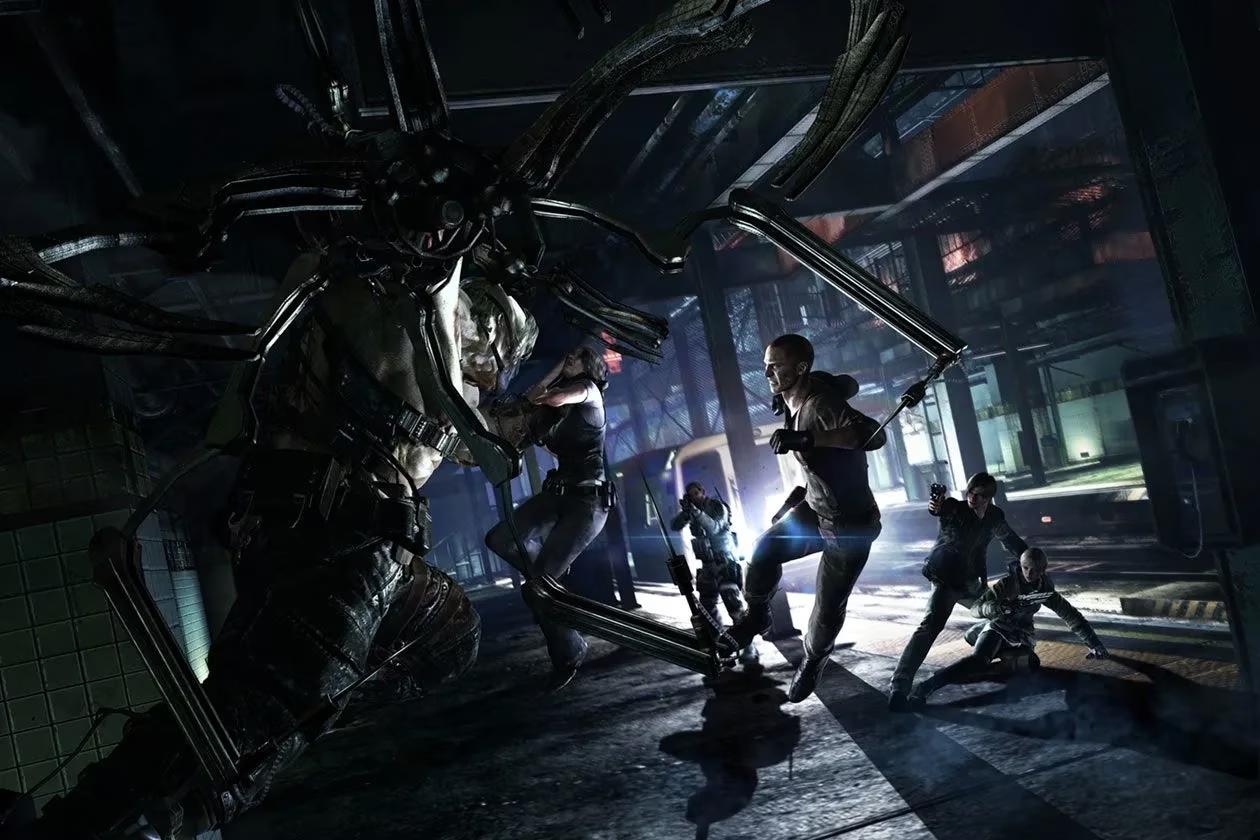
But the landscape has changed. The success of the recent remakes is not just a financial victory; it is a philosophical one. We have witnessed Capcom relearn the language of dread, the grammar of constrained resources and oppressive atmosphere. A remake of Resident Evil 6 would not be a simple coat of paint on a crumbling wall. It would be a total architectural redesign. The first, most crucial lesson? Subtlety. The original was a scream that never faded into silence, leaving the audience numb. A new version could be the slow, creeping cold that precedes the storm.
Imagine it: a global threat that doesn't announce itself with city-leveling fireworks in the first act. Let it be a whisper, a series of connected, horrific incidents from Eastern Europe to a rain-slicked Chinese metropolis, each a piece of a puzzle our separated heroes must solve. The tension wouldn't come from dodging a helicopter crash every ten minutes, but from the dawning, awful realization of the scale, a realization that settles in the gut like a shard of ice. The action, when it inevitably erupts, would mean something. It would be a release of built-up terror, not a constant, exhausting noise.
Structural Reinvention: A Blueprint for Fear
The original's four-campaign structure was its narrative Achilles' heel, a spiderweb of threads that never wove into a coherent tapestry. A remake must be ruthless:
-
Consolidate the Narrative: Two, maximum, interwoven campaigns. Perhaps one follows Leon and Sherry, a pairing steeped in shared trauma from Raccoon City, navigating political deceit. The other could pair Chris, burdened by the loss of his team, with a reimagined, deeply integrated Piers Nivans, forging a bond that isn't cut short by narrative whiplash. Ada's role should be a haunting counter-melody throughout both, not a disconnected postscript.
-
Depth Over Breadth: Confine the journey to a handful of iconic, meticulously crafted locations instead of a checklist of countries. Let us truly inhabit a cursed, sprawling bioweapon research facility in the mountains or a decaying, monster-infested urban district. Global scale can be felt through the pervasive nature of the infection, not just a change of backdrop.
-
Reclaim the Horror: The monsters should be nightmares given form, not just bullet sponges. The original's final boss, a grotesque parody of excess, could be transformed. Instead of a billionaire's tentacled dinosaur, the ultimate threat could be something horrifyingly personal—a corruption of a core ideal, a betrayal that strikes at the heart of what these characters fight for.
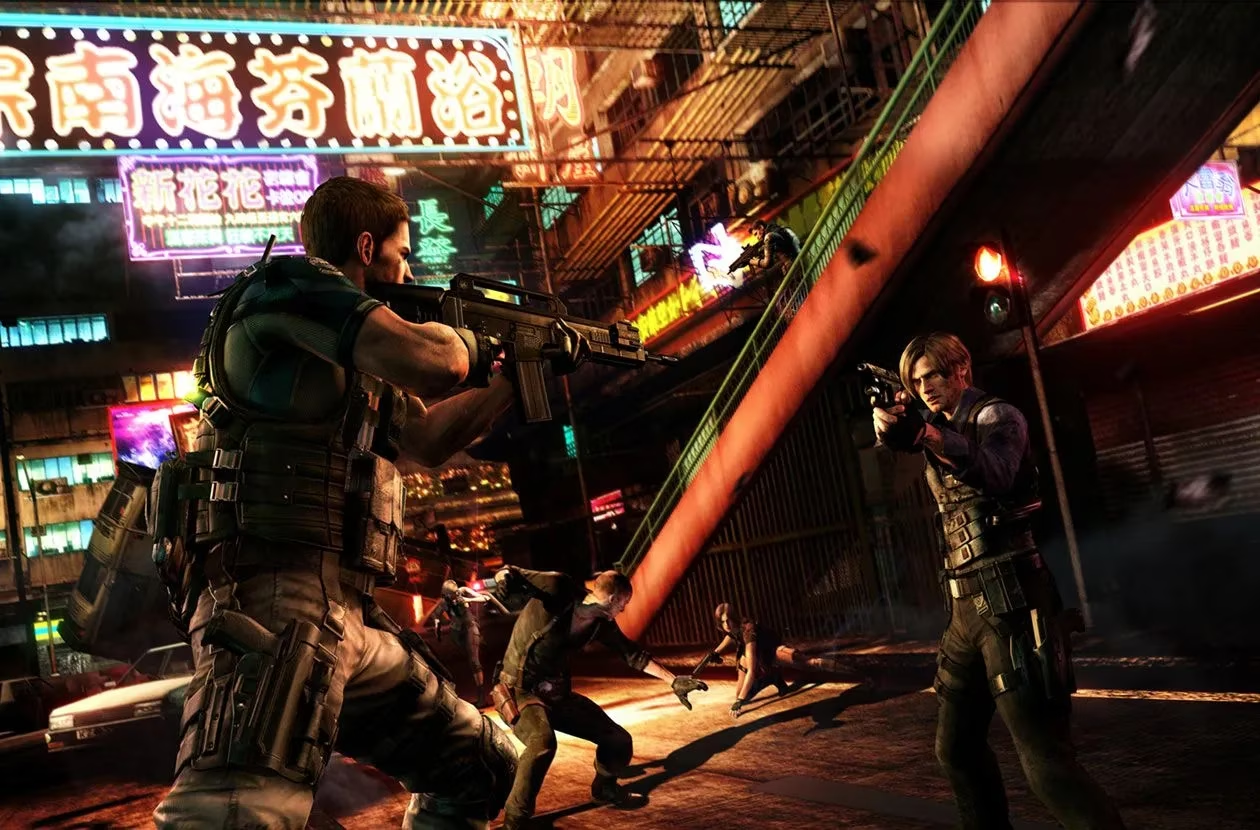
The gunplay, once as satisfying as trying to thread a needle during an earthquake, must be rebuilt from the ground up with the weight and precision of the RE2 and RE4 remakes. Every bullet must count, and every encounter should be a tactical puzzle where running is often wiser than fighting. The awkward partner mechanics should evolve into a seamless system of desperate cooperation, where saving your ally feels vital, not like babysitting a malfunctioning AI.
This is the true potential. A Resident Evil 6 remake could be the series' magnum opus of converging timelines, a point where all the scattered horrors of the past coalesce into a single, overwhelming dread. It would be an opportunity to fix the foundational cracks, to take that brilliant idea of a united front against the darkness and execute it with the learned craftsmanship of a studio reborn. It wouldn't just be a remake; it would be a redemption. A chance to hear that discordant 2012 melody not as a failure, but as a first, rough draft of a symphony we were always meant to hear. I stand here, a survivor of countless nightmares, and I hope—I truly hope—Capcom is listening to that same, silent, promising refrain.