How 2023's Remakes Redefined Linear Level Design
In 2023, a wave of remakes and remasters crashed over the industry: EA's Dead Space, Capcom's Resident Evil 4, Nintendo's Metroid Prime Remastered, Bloober Team's Layers of Fear, and Nightdive Studios' System Shock. To a casual observer, they looked like nostalgia. To a level designer in 2026, they look like a masterclass in restraint, density, and trust.

Most of those games, except Layers of Fear with its dreamlike exploration, placed players inside sprawling, intricate environments and asked them to make sense of the space. The Ishimura's guts, the village and castle of Resident Evil 4, the labyrinthine station of System Shock, the interconnected regions of Tallon IV—these were not open worlds, but they were not straight lines either. They were compact, dense, and rewarding. That combination felt increasingly rare in modern triple-A design.
By 2026, the contrast had become a case study. Many modern linear games, such as Final Fantasy 16 and God of War Ragnarok, share an almost identical approach: funnel the player down extremely linear levels with little branching, stop at intervals for combat encounters of escalating difficulty, then end with a flashy boss fight. The Dead Space remake versus The Callisto Protocol makes the difference obvious. Dead Space let players get lost in the intricate guts of the Ishimura. The Callisto Protocol kept scooting them along straightforward corridors. It would take more effort to get lost than to reach the destination.
Open worlds had their own triumphs. Elden Ring and The Legend of Zelda: Tears of the Kingdom were undisputed masterpieces of 2022 and 2023, both ridiculously open-ended. But the choice should not be between thoughtful open worlds and linear games that hurry players along like water slides. Resident Evil 4 Remake, Dead Space, System Shock, and Metroid Prime Remastered were not open-world games, and that is precisely why they pointed to a better way.
All of them began with source material that was fairly small by modern standards. That allowed their teams to drastically improve graphical presentation while keeping the game at an achievable size. Metroid Prime Remastered did not add new map content; it focused on quality-of-life features like a hint system and new control schemes. Resident Evil 4 Remake and Dead Space took a more thorough approach, overhauling graphics while expanding or revising levels from the originals. These games were bigger than they used to be, but modest by contemporary triple-A standards.
The Remake Design Matrix
| Game | Design Approach | Lesson for 2026 |
|---|---|---|
| Dead Space (2023) | Overhauled graphics, expanded the Ishimura, allowed players to get lost | Intricate spaces can be linear without hand-holding |
| Resident Evil 4 (2023) | Revised levels, modernized combat, preserved pacing | Expansion can respect the original rhythm |
| Metroid Prime Remastered | Quality-of-life improvements, no new map content | Not every remake needs new content to feel new |
| System Shock (2023) | Faithful remake with modern controls | Immersive sims thrive on dense, systemic levels |
| Layers of Fear | Dreamlike exploration logic | Not all linearity is the same |
A level designer in 2026 might distill the lessons into a simple checklist:
-
🧭 Let players get lost—briefly. Confusion can be a tool, not a failure.
-
🗺️ Make levels dense, not vast. A compact space can hold more discoveries than an empty field.
-
🎯 Aim for modest scope. A smaller game can be finished, polished, and memorable.
-
🧠 Trust player intelligence. Arrows on walls are not the only way to guide.
-
⏳ Respect the source material's size. A classic does not need to become a hundred-hour epic.
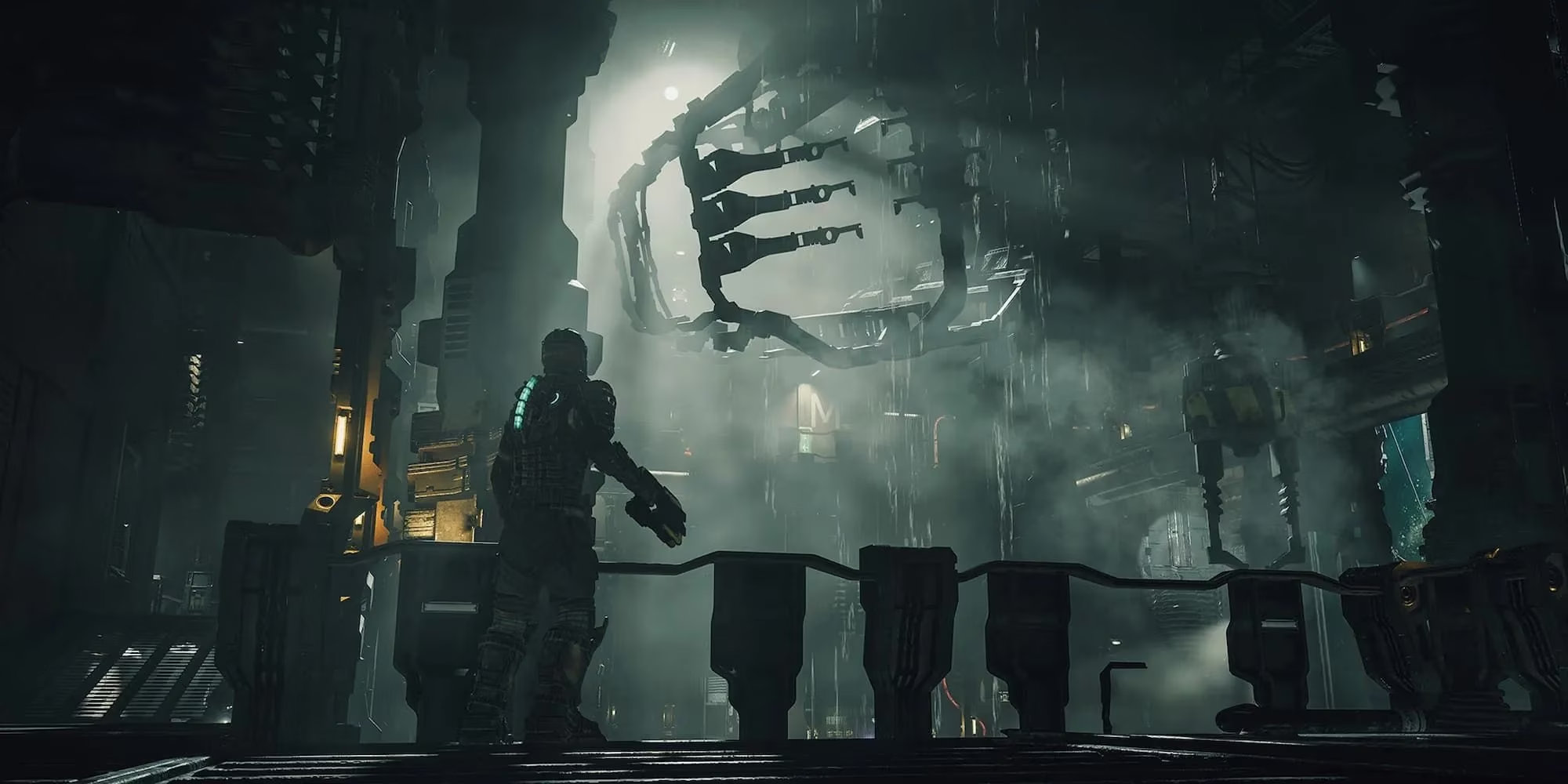
As game budgets, development cycles, and world sizes continued to swell into 2026, these remakes offered a helpful corrective. They are still classics, and developers should notice that none of them are massive. Learning to aim for something humble again seems like the first step toward getting linear games back on track. The industry does not need every game to be a remake, but it can learn from the ones that remembered how to make a space feel worth exploring. Not everything needs to be remade, but everything can learn from these remakes.
In the end, the 2023 remakes were not just nostalgia. They were a quiet argument for design that respects the player's time, curiosity, and intelligence. By 2026, that argument had only grown louder.