The Future of Survival Horror: Resident Evil's Potential Open World Evolution
The shadows of the Resident Evil franchise stretch long and winding, a testament to its decades-long journey through the heart of survival horror. From the claustrophobic, fixed-camera terror of its 1996 debut to the revolutionary third-person action of the mid-2000s, the series has continually reinvented itself. While the path grew uncertain in the 2010s, the franchise rediscovered its chilling core with Resident Evil 7, pivoting once more toward intimate, first-person dread. Now, whispers on the wind suggest the next evolution is not a step back into confined corridors, but a bold leap into vast, uncharted territory. The concept of an open-world Resident Evil might seem a dissonant chord to purists, yet recent triumphs have proven the series can thrive on a grander scale, its horror breathing in wider spaces.
Recent chapters in the saga have quietly laid the stones for this potential future. Resident Evil 4 Remake, while honoring the linear pulse of its predecessor, offered brief, tantalizing vistas of freedom. The early village sequence begins as a series of contained, desperate struggles, but soon unfolds. Players are granted agency over its interconnected lanes and shadowed homes, a space to backtrack, to explore, to scavenge for resources previously missed in the panic. It is not a true open world, but a glimpse—a proof of concept that a cohesive, larger-scale Resident Evil environment can maintain tension and atmosphere.
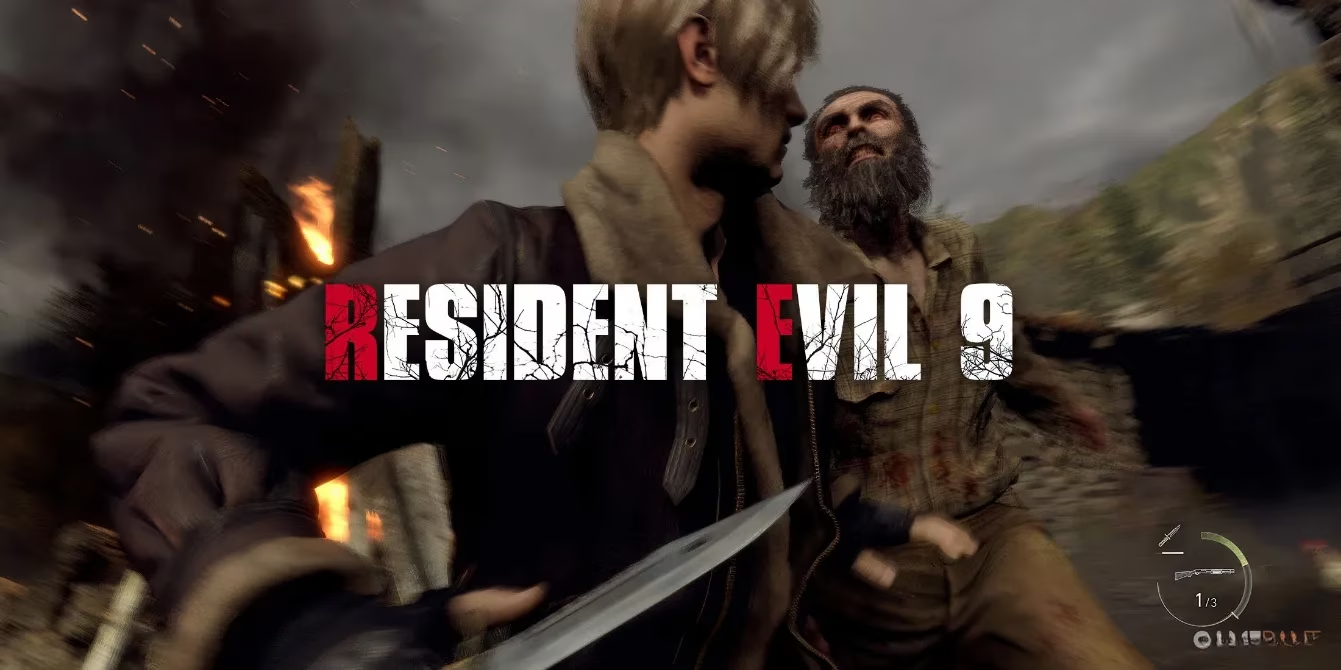
The most liberated moment, however, arrives with the boat section. Here, from a watery central hub, players can chart their own course between islands and caverns, tackling objectives in an order of their choosing. This fleeting sequence sings a quiet promise: the mechanics of survival horror—resource management, environmental puzzle-solving, tense combat—can flourish without the rigid hand of linearity. If the rumored Resident Evil 9 does embrace an open world, this sequence should be its blueprint, its scale expanded but its intimate, player-driven formula cherished and preserved.
This experimentation with space is not entirely new. Resident Evil Village wove its gothic locales around a central hub that felt more open and explorable than any before it, connecting distinct domains of terror in a landscape that invited curiosity alongside fear. The foundation for a broader world was being textured, piece by haunting piece.
Beyond geography, Resident Evil 4 Remake seeded another crucial element for an open-world future: organic side content. Scattered blue request notices transformed the environment into a canvas of optional objectives.
Examples of Side Mission Archetypes:
| Mission Type | Player Objective | Typical Reward |
|---|---|---|
| Hunter-Gatherer | Find and deliver specific rare resources (e.g., a stolen jewel). | Precious gems, weapon parts. |
| Extermination | Eliminate a powerful, marked enemy in a designated area. | Valuable treasure, crafting materials. |
| Exploration | Locate and destroy all hidden targets (like blue medallions). | Spinel currency for exclusive upgrades. |

These missions, while simple, wove naturally into the core loop of survival. They rewarded thorough exploration and careful combat, making every detour feel potentially vital. An open-world Resident Evil must learn this lesson: side content cannot be frivolous. It must deepen the horror, enhance the scarcity, and make every discovered note, every hidden path, feel like a thread in the larger, terrifying tapestry. The rewards must be meaningful—a new weapon mod, a recipe for stronger healing, a clue to a deeper lore—tying optional exploration directly to the player's chance of survival.
Imagine, then, a world where the isolation is not of a hallway, but of a region. A contaminated valley, a ruined metropolitan quarantine zone, or a decaying coastal archipelago serving as the playground. The core tenets remain sacred:
-
Atmosphere Over Everything: The world must drip with dread. Fog-laden forests, derelict research facilities reclaimed by nature, abandoned villages where something still watches from the windows.
-
Meaningful Scarcity: Resources are never plentiful. Every bullet found in a deserted police cruiser, every green herb spotted in a creek bed, is a triumph. The open world amplifies the anxiety of the search.
-
Dynamic Threats: Enemies are not just placed; they inhabit. Plagas-infected wolves that hunt in packs through the pine barrens, mutant patrols that follow set routes, and rare, terrifying "apex" bioweapons that claim certain territories, making travel a constant risk-assessment.
-
Environmental Storytelling: The grandest narrative is told in the silence. A child's drawing in a boarded-up house, a series of failed barricades, emergency broadcasts repeating into static—the world itself becomes the primary document of the catastrophe.
The evolution would be profound, yet rooted. It would shift the perspective from surviving a haunted house to surviving a haunted world. The safe room is no longer a specific door; it is any momentarily secure location you can fortify and catch your breath. The terror evolves from jump scares around corners to the creeping dread of a long journey through hostile territory as night falls and resources dwindle.
In 2026, the genre continues to expand, and Resident Evil has never been a series to watch from the sidelines. It has always been the one to reshape the landscape of horror gaming. An open-world iteration is not a betrayal of its origins, but perhaps their ultimate expression—the realization that true horror is not just about the monsters you are locked in with, but about the vast, indifferent world they have inherited, and your fragile, desperate journey through it. The blueprint is already written, hidden in the village lanes and island chains of its recent past, waiting for the right moment to expand into a symphony of large-scale, explorable fear.
This assessment draws from GamesIndustry.biz, framing how an open-world shift for Resident Evil would be as much a production and pacing challenge as a design opportunity—balancing exploration freedom with tightly tuned tension, and ensuring side objectives meaningfully reinforce scarcity and progression rather than dilute fear. In that context, the RE4 Remake’s hub-like stretches and merchant-driven optional tasks read less like detours and more like a scalable template for sustaining survival-horror stakes across a larger, systemic play space.